A clutch is one of those parts you rarely think about until it stops working the way it should. For Honda owners around Gatton, a Honda Clutch Replacement is one of the more common repairs we handle, and for good reason: Honda’s manual transmission vehicles are popular workhorses in the Lockyer Valley, used daily by commuters, tradies, and families who put real kilometres on them. The clutch system transfers power from the engine to the gearbox, and when the friction disc, pressure plate, or release bearing wear out, the whole drivetrain suffers. Catch it early and you’re looking at a straightforward job. Leave it too long and you risk secondary damage that costs more to fix.
Signs Your Honda Clutch Needs Attention
Honda clutches don’t fail overnight. There’s usually a gradual change in how the car feels, and if you know what to look for, you can get it sorted before you’re stuck on the side of the Warrego Highway.
- Slipping clutch: The engine revs climb but the car doesn’t accelerate as it should, especially under load or when pulling away on a hill. This is a classic sign the friction disc has worn thin.
- High biting point: The pedal needs to be almost fully released before the clutch engages. On newer Hondas, a rising bite point often means the disc is near the end of its life.
- Difficulty shifting gears: Crunching or resistance when moving between gears, particularly on Honda Civic or Jazz models, can point to a worn release bearing or a pressure plate that’s not fully disengaging.
- Vibration on take-off: A shuddering sensation when pulling away from a standstill suggests glazing on the clutch disc or a contaminated flywheel surface.
- Burning smell after hills or towing: If you catch a sharp smell after climbing a grade or towing, the clutch is likely being overworked and may be slipping without obvious symptoms yet.
- Noisy pedal: A squealing or rattling noise when pressing or releasing the clutch pedal often indicates a worn release bearing, sometimes called a throw-out bearing.
Any one of these signs is worth having looked at. Two or more appearing together usually means the clutch is approaching the end of its service life.
How We Approach Honda Clutch Replacement in Gatton
We start with a proper inspection before any parts are ordered. On Hondas, that means assessing the hydraulic clutch circuit as well as the mechanical components. Many Honda models use a hydraulic actuation system rather than a cable, so we check the master cylinder and slave cylinder for fluid leaks or pressure loss that could mimic a worn clutch. If the hydraulics are fine, we move to the clutch assembly itself.
Once the gearbox is dropped, we don’t just swap the friction disc. We inspect the pressure plate, the flywheel surface, and the release bearing as a set. On high-mileage Hondas, particularly models like the Accord Euro, Civic Type R, or older Integra, the flywheel often needs machining or replacement alongside the disc and pressure plate. Skipping the flywheel inspection is a false economy, because a worn or heat-cracked flywheel will destroy a new clutch disc in short order.
Parts selection matters on Hondas. We source OEM-specification or genuine-equivalent clutch kits that meet Honda’s original tolerances. This is especially relevant for Honda’s VTEC-equipped engines, where clutch take-up characteristics are matched to the engine’s torque delivery. Fitting an undersized or mismatched clutch kit can affect how the car drives long after the repair is done.
Honda-Specific Considerations
One detail worth knowing: some Honda Civic and Jazz models have a known tendency for the clutch master cylinder to develop internal leaks as the vehicle ages, which causes the pedal to slowly sink to the floor under sustained pressure. This gets misdiagnosed as a worn clutch fairly often. We test the hydraulic system thoroughly so you’re not paying to replace parts that don’t need replacing.
What Affects the Cost and Time Involved in Clutch Replacement?
The main variables are the condition of the flywheel, which parts are needed (disc only versus a full kit including pressure plate and bearing), and whether the hydraulic components need attention at the same time. Honda models with a dual-mass flywheel, found on some diesel or larger-displacement variants, can add to the cost because dual-mass flywheels are a more complex assembly. Labour time also varies depending on the model, since gearbox access on a Honda Jazz differs significantly from an Accord Euro or a CR-V.
We’ll give you a clear picture of what’s needed before work begins. No surprises, no padding the quote with parts that aren’t warranted.
Why Gatton Drivers Bring Their Hondas to Us
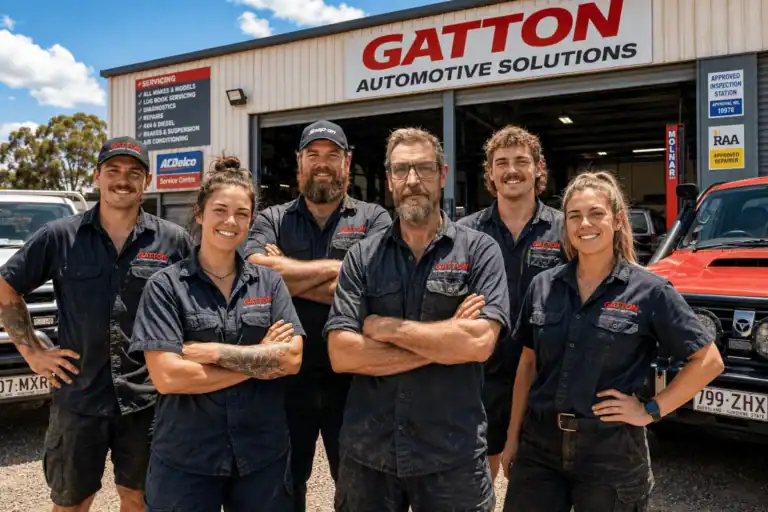
Gatton Automotive Solutions handles everything from everyday Civics and Jazzes through to commercial vehicles and heavy equipment, all under one roof. You won’t need to drive to Ipswich or Toowoomba for a clutch job. We source parts directly, which keeps things moving, and we’ll advise you honestly about what needs doing now versus what can wait. Our five-star rated service reflects the kind of straightforward service we think every Honda owner deserves.
We also handle roadworthy certificates on-site, which is useful if your clutch failure has pushed the vehicle into a state where it needs a fresh RWC before returning to the road. From general mechanical work for everyday drivers all the way to heavy vehicle and equipment servicing, smash repairs, custom paintwork, suspension upgrades, and tyre supply and fitting, everything is taken care of in one place.
If your Honda’s clutch is slipping, noisy, or just doesn’t feel right, Call Us Now or Book Your Free Inspection online. We’re here in Gatton and ready to get you sorted.