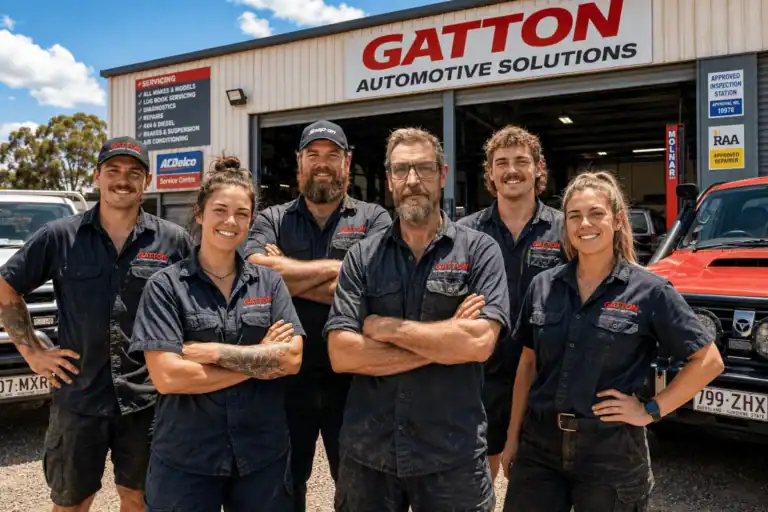
A clutch is one of those components that quietly does its job for years before giving you any trouble. When it does start to go, the signs are hard to miss. Japanese vehicles clutch replacement is something we handle regularly at Gatton Automotive Solutions, and there’s good reason for that: brands like Toyota, Nissan, Mazda, Mitsubishi, Honda, and Subaru are among the most common vehicles on the road across the Lockyer Valley. Whether you’re driving a workhorse ute to a job site or ferrying the kids around in a family wagon, a failing clutch means the car isn’t doing what you need it to do.
Signs Your Japanese Vehicle’s Clutch Needs Attention
Clutch problems don’t usually appear overnight. They develop gradually, and knowing what to look for can save you from a breakdown on the Warrego Highway or out on a rural road where help isn’t close.
- Slipping: The engine revs climb when you accelerate, but the car doesn’t pick up speed to match. This is one of the clearest signs the clutch disc is worn and losing its grip on the flywheel.
- Difficulty engaging gears: If the gear lever feels stiff, grinds going in, or won’t engage smoothly, the issue could be with the clutch itself or the hydraulic system that operates it.
- Clutch pedal sitting high or low: A change in pedal feel, or a pedal that’s either spongy or requires much more travel than usual, often points to hydraulic wear or a worn pressure plate.
- Burning smell: A sharp, acrid smell after hill starts or heavy use in traffic usually means the clutch is slipping badly enough to generate friction heat.
- Shudder on take-off: If the vehicle judders or shakes when you pull away from a stop, it can indicate a glazed clutch disc, worn mounts, or contamination on the friction surfaces.
Some of these symptoms overlap with other drivetrain issues, so a proper inspection matters before any parts are ordered.
How We Approach Japanese Vehicle Clutch Replacement in Gatton
Japanese manufacturers design their clutch systems with some significant differences across model lines, so a one-size-fits-all approach doesn’t work here. A Nissan Navara D22 has a very different clutch arrangement to a Subaru Forester or a Honda Jazz. Before any work begins, we inspect the full clutch assembly, the flywheel condition, the hydraulic circuit including the master and slave cylinders, and the gearbox input shaft seal for any signs of leakage that could contaminate a new clutch.
On many Toyota and Mazda models, dual-mass flywheels (a two-part flywheel that absorbs drivetrain vibration) have become standard. These are more complex and more expensive than solid flywheels, and they need to be assessed before we quote. Replacing a clutch kit on a solid-flywheel setup is a different job to one that involves a worn dual-mass unit. We’ll tell you clearly which situation you’re in before the work starts.
Where a resurfaced or replaced flywheel is required, that’s done as part of the same job rather than cut as a corner. We source OEM-specification or equivalent-quality parts suited to each Japanese make and model. Using correct clutch kits matched to the vehicle’s torque rating and design matters for longevity, particularly on performance variants or 4WDs that see hard use.
Hydraulic Clutch Systems on Modern Japanese Vehicles
Most newer Japanese vehicles use a hydraulic clutch rather than a cable. If the master or slave cylinder is leaking or failing, new clutch friction components alone won’t fix the problem. On some Mitsubishi and Nissan models, the slave cylinder is located inside the gearbox bell housing, meaning it’s replaced as part of the clutch job rather than separately. We check the full hydraulic path as standard during the inspection so nothing is missed.
What Affects the Cost and Time for Clutch Replacement?
Clutch replacement is a labour-intensive job on most vehicles, and the variables that affect cost are worth understanding. Access to the clutch requires removing the gearbox, which is more involved on all-wheel drive vehicles like a Subaru Outback or Forester than on a rear-wheel drive ute. Vehicle age, the condition of the flywheel, whether hydraulic components need replacing, and the specification of parts all play into the final cost.
OEM or genuine-equivalent parts are generally recommended for Japanese vehicles if you’re intending to keep the car for a number of years. Budget-grade alternatives are available, but the lifespan difference is usually noticeable. We’ll walk you through the options honestly so you can make a call that suits your vehicle and your budget.
Why Choose Gatton Automotive Solutions for Your Clutch Replacement?
We’re a full-service workshop based right here in Gatton, which means there’s no need to drive to Ipswich or Toowoomba for a job this size. We work on everything from everyday passenger cars and 4WDs through to trucks and heavy equipment, so a clutch replacement on a Japanese ute or SUV is well within our daily scope. Roadworthy certificates are issued on-site, and if your vehicle needs smash repairs, suspension work, or tyre fitting while it’s in, all of that is handled under the one roof.
Pricing is straight and honest. We don’t recommend work that isn’t needed, and we explain what we find before we start. Our five-star reviews reflect that approach more than any certificate on the wall. If the job touches something unexpected once the gearbox is out, we’ll call you before proceeding.
If your vehicle is showing any of the symptoms above, or it’s been a while since the clutch was last looked at, Book Your Free Inspection online or Call Us Now to speak with the team. We’re here for Gatton drivers and the broader Lockyer Valley community, and we’ll get you back on the road with a clear idea of what was done and why.