A slipping or grinding clutch is one of those problems that tends to get worse quickly if you leave it. For Volkswagen owners in Gatton, getting Volkswagen clutch repair handled by a workshop that understands the brand makes a real difference to how long the fix lasts. VW models across the Golf, Polo, Tiguan, Amarok, and Passat ranges all use clutch systems with specific tolerances and hydraulic characteristics that differ from your average Japanese or domestic vehicle. Getting the diagnosis right from the start saves time, money, and the frustration of coming back with the same problem a few months later.
Signs Your Volkswagen Clutch Needs Attention
VW clutch problems rarely appear without warning. Most drivers notice one or more of the following before things get serious:
- Slipping under load: The engine revs climb but the car doesn’t accelerate in proportion. This is especially common when pulling out of intersections or overtaking on the highway around the Lockyer Valley.
- High bite point: The clutch pedal engages very close to the top of its travel rather than partway through. This often means the friction material is worn thin.
- Juddering on take-off: A shudder or vibration through the pedal and drivetrain when pulling away from a stop, particularly on inclines.
- Difficulty selecting gears: Grinding or resistance when changing gears, even with the pedal fully depressed, can point to a worn clutch plate or a problem with the release bearing.
- Burning smell: A sharp, acrid smell after driving in traffic or on a steep grade is often clutch friction material overheating from slipping.
If you’re noticing any of these symptoms, it’s worth booking an inspection rather than waiting. A worn clutch that’s still driveable today can leave you stranded tomorrow.
How We Diagnose and Repair Volkswagen Clutches
Volkswagen vehicles, particularly those with the DSG dual-clutch automatic transmission fitted to many modern Golf and Tiguan models, require a different diagnostic approach to a traditional manual clutch setup. Before we pull anything apart, we carry out a thorough assessment to confirm what’s actually failing. This includes a road test to replicate the symptom, inspection of the clutch pedal travel and hydraulic pressure where applicable, and a check of the flywheel condition.
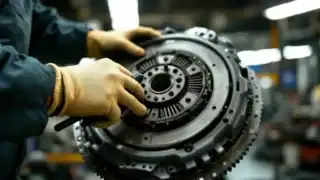
On manual transmission VW models, we remove the gearbox to inspect the clutch plate, pressure plate, and release bearing as a unit. These three components typically wear together, so replacing them as a set avoids the situation where a new clutch plate is fitted onto a pressure plate that’s already at the end of its service life. The flywheel is inspected for heat cracking, scoring, and runout. If it can be resurfaced, we’ll tell you. If it needs replacing, we’ll tell you that too.
For VW Amarok owners, the dual-mass flywheel is a flywheel design that uses an internal spring-damper system to smooth drivetrain vibration. It is a known wear item at higher kilometres and is worth assessing at the same time as a clutch replacement. Ignoring a worn dual-mass flywheel when replacing the clutch often means the job needs to be redone sooner than it should.
We source parts that meet OEM specifications for Volkswagen applications. This matters because VW clutch systems are engineered to tighter tolerances than many aftermarket parts are calibrated for, and using undersized or mismatched components can affect pedal feel and clutch life.
What Affects the Cost and Time Involved in Clutch Repair?
Clutch repair is one of those jobs where the labour is often the larger part of the cost. Removing and refitting a gearbox takes time regardless of the parts involved, so the condition of the flywheel, whether it needs machining or replacement, has a meaningful impact on the final price. The model matters too. A Polo with a cable-actuated clutch is a different job to a Tiguan with a hydraulic system or an Amarok with a dual-mass flywheel assembly.
Parts availability for Volkswagen vehicles is generally good in Australia. We handle our own parts sourcing here in Gatton, so you’re not waiting on you to chase down a supplier yourself. We’ll advise you on the choice between OEM-equivalent and genuine parts based on your vehicle’s age, how long you plan to keep it, and your budget. That conversation happens before we start, not after.
Volkswagen Clutch Repair in Gatton, Without the Drive to Toowoomba or Ipswich
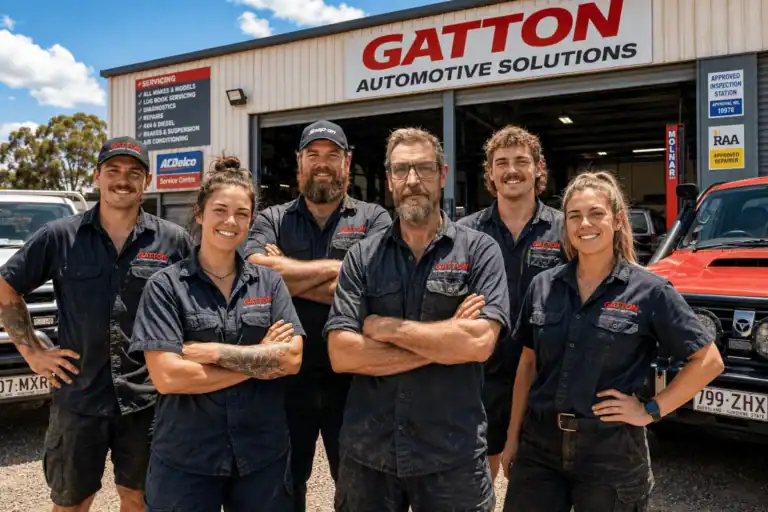
There’s no need to take your VW an hour down the road for a quality clutch repair. Gatton Automotive Solutions handles everything in-house, from the initial diagnosis through to the finished job. We work on all vehicle types, cars, 4WDs, utes, and trucks, and our approach is the same regardless of the job size: tell you what’s needed, explain why, and get it done properly.
We’re locally owned and operated in Gatton, and we’ve built our reputation on straightforward advice and fair pricing. No unnecessary work, no upselling, no vague estimates. If the clutch doesn’t need replacing yet, we’ll tell you that too.
Our reviews speak for themselves, with five-star ratings from local customers across the Lockyer Valley. We issue roadworthy certificates on-site, handle smash repairs and panel work in-house, and also service heavy equipment and farm machinery, so whatever you drive, we can help.
If your VW is showing clutch symptoms or you just want it looked at before it becomes an urgent problem, Call Us Now or Book Your Free Inspection online. We’re here in Gatton and ready to help.