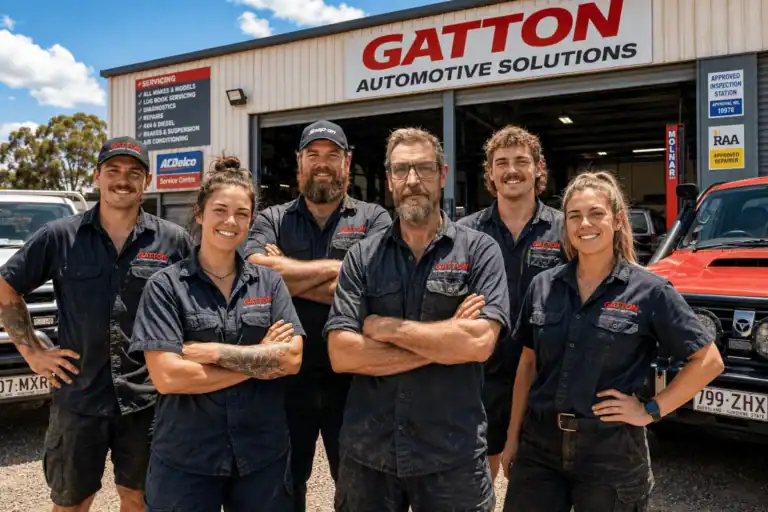
Suspension does more than just smooth out a rough road. It keeps your Isuzu’s tyres in contact with the ground, maintains steering control, and protects everything from your chassis to your cargo from the kind of stress that builds up kilometre after kilometre. When suspension components wear out or fail, the effects show up in the way your vehicle handles, rides, and brakes. Isuzu suspension replacement is one of the more common jobs we carry out here in Gatton, particularly on D-Max utes and MU-X wagons that see a fair share of corrugated dirt roads, paddock tracks, and loaded towing.
Signs Your Isuzu Suspension Needs Attention
Suspension wear tends to happen gradually, which means drivers often adapt to the changes without realising how much has changed. By the time the handling feels noticeably off, the components may have been worn for some time. A few specific signs are worth taking seriously.
- Bouncing or wallowing after bumps – if your Isuzu keeps bouncing after hitting a rise or dip rather than settling quickly, the shock absorbers are likely past their useful life.
- Nose-diving under braking – the front of the vehicle dipping sharply when you brake is a strong indicator that front struts or shocks are no longer doing their job properly.
- Uneven or accelerated tyre wear – suspension that’s out of alignment or has worn components causes tyres to contact the road unevenly, often showing as feathering or wear on one edge.
- Pulling or drifting during cornering – worn ball joints or control arm bushes can cause the vehicle to wander or feel imprecise, particularly at highway speeds or under load.
- Knocking or clunking over rough surfaces – loose or worn suspension bushes, end links, or sway bar components often make themselves known with metallic knocking sounds over corrugations or speed humps.
- Sitting lower on one corner – a coil spring that has broken or sagged will cause one corner of the vehicle to sit visibly lower than the others.
If you’re running your D-Max or MU-X as a workhorse, loaded frequently, or regularly driving on rough roads around the Lockyer Valley, suspension components can wear faster than on a vehicle used only for light commuting. That’s worth factoring in when deciding whether to get things checked.
How We Handle Isuzu Suspension Replacement
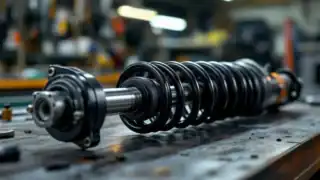
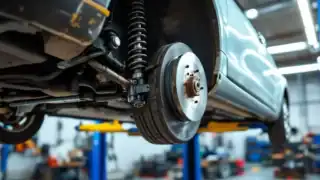
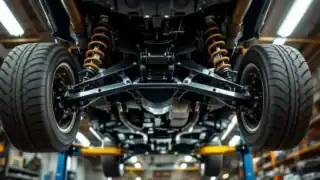
We start with a proper visual and hands-on inspection rather than guessing from symptoms alone. That means checking shock absorbers for oil leakage and physical damage, testing struts for damping resistance, inspecting coil springs for cracks or sagging, and assessing bushes, ball joints, and end links for play or deterioration. For Isuzu vehicles, we pay particular attention to the upper and lower control arm bushes on the front end, which are a known wear point on higher-kilometre D-Max models, especially those that have done towing duty.
We also check the rear leaf spring packs on D-Max utes for broken or shifted leaves and worn shackles. These are easy to overlook but directly affect load-carrying stability and rear alignment.
Once we’ve identified what needs replacing, we’ll walk you through what we found and why each component matters before any work starts. We use OEM-spec or genuine-equivalent parts suited to Isuzu’s suspension geometry and load ratings. Fitting undersized or mismatched parts on a vehicle built to carry a GVM of over 3,000 kg is not something we’ll do, regardless of what’s cheaper in the short term.
Where a suspension replacement affects wheel alignment, we carry out a wheel alignment check as part of the process. Fitting new components and sending the vehicle back out without checking alignment is a false economy that accelerates tyre wear and affects handling.
What Affects the Cost and Time Involved
Suspension replacement on an Isuzu varies depending on how many components need replacing, whether it’s a front or rear job, and which parts are required. A straightforward pair of rear shock absorbers is a different scope of work to a front strut assembly replacement with new ball joints and control arm bushes. The age and condition of surrounding hardware also plays a role. Corroded mounting hardware on older vehicles can add time to what looks like a simple job.
Parts availability for Isuzu D-Max and MU-X is generally good. We handle our own parts sourcing, which keeps things moving without unnecessary delays waiting on third-party orders. Whether you’re after OEM-equivalent components or a suspension upgrade suited to towing and off-road use, we can advise on what suits your vehicle and how you use it.
Isuzu Suspension Work in Gatton and the Lockyer Valley
Driving in and around the Lockyer Valley puts suspension under real pressure. Loaded utes on rural roads, farm equipment tracks, and the occasional corrugated back road all add up. Getting this work done locally means you’re not driving an hour to Ipswich or Toowoomba and back with a vehicle that needs attention now.
Gatton Automotive Solutions handles the full range of suspension work in-house, from everyday shock and strut replacements through to suspension upgrades and lift kits. We also carry out roadworthy certificate inspections on-site, which is useful if a suspension fault has come up during a roadworthy check. Our workshop covers cars, 4WDs, utes, trucks, and heavy equipment, so whatever you’re driving, we’ve seen it before. With five-star reviews, our reputation in the local area speaks for itself.
If your Isuzu is showing any of the signs above, or it’s simply been a while since the suspension was looked at, use the Book Your Free Inspection button to lock in a time online, or Call Us Now and we’ll sort out a time that works for you. Gatton drivers don’t need to travel far for quality Isuzu suspension work.