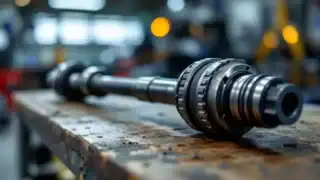
A CV axle — short for constant velocity axle — is what transfers drive from your Mercedes’ transmission to the wheels, allowing the wheels to steer and move up and down over bumps while still receiving power smoothly. When a CV axle or its joints start to wear, you’ll notice it. Mercedes CV axle replacement is one of those jobs where early attention saves you from a much bigger repair bill down the track. At Gatton Automotive Solutions, we handle this work regularly across a range of Mercedes models, and we know exactly what to look for when these components start to fail.
What Does a Failing Mercedes CV Axle Feel Like?
The symptoms of a worn CV joint or axle are usually hard to ignore once they start. The most common one is a clicking or clunking sound when turning – particularly at low speeds in a tight turning circle like reversing out of a driveway. That noise is the outer CV joint struggling to handle the angle and load at the same time.
Other signs that your Mercedes may need CV axle or boot work include:
- Vibration through the floor or steering wheel that gets worse at higher speeds – this often points to a worn inner CV joint or a shaft that’s no longer balanced properly
- Grease splattered around the inside of your wheel or on the tyre sidewall – a torn CV boot (the rubber sleeve that protects the joint) allows grease to escape and exposes the joint to dirt and moisture
- A clunking sound when accelerating from a stop – particularly noticeable in front-wheel-drive Mercedes models
- Pulling or shuddering during acceleration – the axle may be transferring power unevenly to one side
If you’re noticing any of these, it’s worth getting the car checked before the joint fails completely. A seized or snapped CV axle can leave you stranded, and on some Mercedes models, it can cause secondary damage to the transmission or wheel bearing if left too long.
How We Approach Mercedes CV Axle Diagnosis and Repair in Gatton
Mercedes-Benz vehicles use a range of driveshaft and CV joint configurations depending on the model and drivetrain. C-Class, E-Class, and GLC models, for example, have specific axle shaft designs that differ from older 190-series or W202 models. We start with a visual inspection and a road test to replicate the symptom, then raise the vehicle and inspect the CV boots, joint play, shaft condition, and any grease contamination.
One thing that’s specific to Mercedes vehicles is the importance of checking the inner tripod joint assembly. On many M-B models, the inner joint uses a tripod (three-roller) design rather than a ball-type joint. This type wears differently, often producing a shudder at low speed under load rather than a sharp click. Misdiagnosis here means replacing the wrong end of the shaft, which is a waste of time and money.
Where only the CV boot is split but the joint itself is undamaged, we’ll discuss whether a CV boot replacement is sufficient or whether the axle shaft should be replaced as a complete unit. On many modern Mercedes vehicles, a replacement axle shaft (also called a CV shaft replacement) is more cost-effective and longer-lasting than regreasing and re-booting an already contaminated joint. We’ll give you a straight answer either way.
We source OEM-specification or genuine-equivalent parts for Mercedes vehicles. CV axle components are safety-related drivetrain parts, and we don’t compromise on fit or quality. Using the correct-spec grease and boot kit matters too – Mercedes-Benz specifies particular joint lubricants, and substituting the wrong type shortens the life of the repair.
What Affects the Cost and Time Involved?
The time and cost of a Mercedes CV axle job depends on a few honest variables. Which axle needs replacing matters – an outer boot replacement on a straightforward front-wheel-drive model is less involved than replacing a full rear driveshaft on an all-wheel-drive GLE or ML-Class. Parts availability for older or less common Mercedes models can add lead time, but we handle parts sourcing in-house so you’re not chasing suppliers yourself.
Labour time varies based on how much disassembly is required to access the axle. Some Mercedes models require partial subframe lowering or hub removal, which adds time. We’ll tell you upfront what’s involved before any work starts.
Why Drivers in Gatton and the Lockyer Valley Choose Us for This Work
We’re a full-service workshop here in Gatton, which means once your Mercedes is in for a CV axle repair, we can also inspect the wheel bearing, brake condition, and suspension components at the same time – all without sending you elsewhere. If there’s related wear, we’ll let you know and leave the decision with you. No pressure, no unnecessary upselling.
Our five-star reviews reflect what we actually do: honest advice, fair pricing, and work done properly. Drivers from across the Lockyer Valley come to us precisely because the alternative is a 45 to 80 kilometre round trip to Ipswich or Toowoomba for work that can be handled right here. That’s a genuine advantage for anyone who values their time.
If your Mercedes is clicking, shuddering, or leaking grease from the wheel area, don’t leave it. Call Us Now or Book Your Free Inspection online – our team in Gatton will take a proper look and give you a clear picture of what’s needed.