Limited Time: Free Windscreen Wipers With Any Service. Subject To Availability.

Locally Owned & Operated
Honest Upfront Pricing
5★ Reviews
All Makes & Models

Verified 5★ Reviews

Top Rated Volkswagen Cv Axle Replacement In Gatton

We diagnose and replace worn CV axles on Volkswagen vehicles right here in Gatton. You get smooth steering and reliable acceleration back, with honest pricing and no unnecessary work.

One-Stop Workshop

Honest Advice

5★ Reviews

VW CV Axle Specialists

Book Your Free Inspection

Tell us what you need and we'll get back to you with a clear quote.

Booking Form
  • Vehicle Details
  • Confirm Vehicle
  • Services
  • Contact Details
Honest Quotes
All Vehicle Types
Local & Reliable

Why Book With Us

Book Your Free Inspection
Drop Off Your Vehicle
We Get to Work
Collect Your Car

A CV axle — short for constant velocity axle — transfers power from your Volkswagen’s transmission to the front wheels while allowing for the full range of steering and suspension movement. When one of these axles starts to fail, the first sign is often a clicking or clunking noise coming from a front corner of the car, particularly when turning. Volkswagen CV axle replacement is one of the more common drivetrain repairs we handle at our Gatton workshop, and catching the problem early usually means a cleaner, less expensive job than waiting until something breaks completely.

Signs Your Volkswagen CV Axle or Joint Needs Attention

Volkswagen models – including the Golf, Polo, Passat, Tiguan, and Transporter – use CV axles on both ends of each front driveshaft. The outer CV joint handles the tight angles involved in steering, and the inner joint deals with the suspension travel as the car rides over bumps. Both joints are protected by rubber boots filled with grease. Once a boot cracks or tears, that grease escapes and grit gets in, and the joint starts to wear rapidly from there.

There are a few clear signs that something is wrong:

  • Clicking or snapping noise when turning: Typically the outer CV joint. The noise often appears when reversing out of a driveway or turning in a car park and gets more obvious at sharper steering angles.
  • Vibration through the floor or steering wheel at speed: This can point to a worn inner joint or an axle that’s no longer running true.
  • Visible grease splattered inside the wheel arch: If a CV boot has split, grease gets flung out under rotation. It’s usually dark, sticky, and hard to miss once you’re looking.
  • Shuddering on acceleration: A failing inner joint can cause a juddering sensation when pulling away from a standstill, especially under load.
  • Clunking over bumps: Less common but possible if the inner joint has significant wear.

If you’re noticing any of these in your VW, it’s worth getting it looked at before the joint fails entirely. A seized or broken CV axle can leave you stranded, and in rare cases, it can cause sudden handling changes while driving.

How We Approach Volkswagen CV Axle Replacement

Because Volkswagen uses a platform-sharing approach across many of its models, CV axle fitments vary even within the same model range depending on engine, transmission, and whether the car has had a production year update. Before we order parts, we confirm the exact specification for your vehicle using the VIN. This step matters more than it might seem – a CV axle that fits a 2015 Golf TSI manual is not necessarily the same part as one for a 2015 Golf TDI DSG, even though the cars look identical.

Our process starts with a thorough inspection of both the axle and the surrounding area. We check the CV boots for cracking or splitting, the CV joints for play and wear, the axle shaft itself for straightness, and the inner joint carrier bearing where applicable. We also look at the hub nut and any associated hardware, since these components often need to be replaced at the same time rather than reused.

For the replacement itself, we work to OEM-spec or quality aftermarket parts depending on the axle, your budget, and parts availability. For most Volkswagen models, quality aftermarket CV axles are a practical and cost-effective choice, and on older or higher-kilometre vehicles, replacing the full axle assembly rather than just rebooting a worn joint often makes better long-term sense. We’ll explain what we find and what the options are before any work begins.

DSG and Automatic Transmission Considerations

On Volkswagen models fitted with a DSG (direct-shift gearbox) or automatic transmission, the inner CV joint interfaces with the transmission output differently than on a manual. Care is needed during removal to avoid damaging the transmission seal or the differential side gear. It’s a detail that matters, and it’s something we account for when booking in VW automatic models for this job.

What Affects the Cost and Time of a CV Axle Replacement?

The main variables are which axle needs replacing (driver’s side front axles often differ from passenger side), whether one or both axles need attention, and parts sourcing for your specific model year. Some Volkswagen axles are readily available locally; others may need to be ordered. We handle parts sourcing directly, so you don’t need to chase anything down yourself.

Labour time depends on the accessibility of the axle in your particular VW and whether any related components – like a stretched hub nut or damaged heat shield – need to be sorted at the same time. We give you a clear picture of costs before we start, and there’s no pressure to approve work you’re not comfortable with.

Getting Your Volkswagen Sorted in Gatton

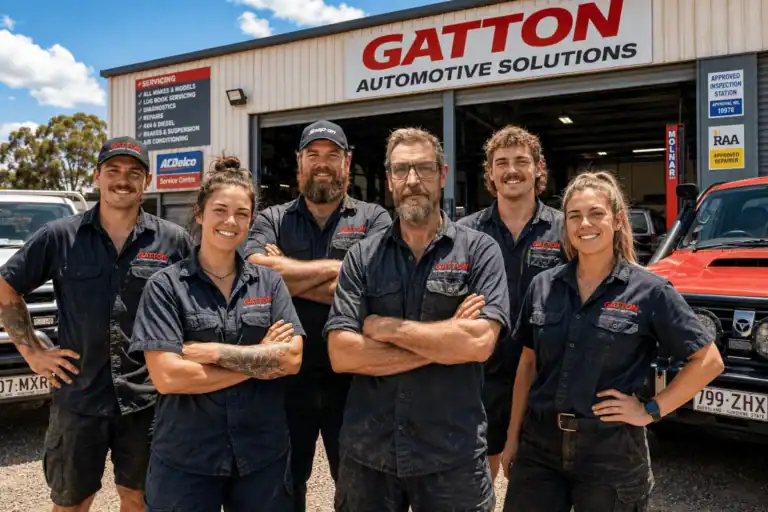
We look after all makes and sizes here at Gatton Automotive Solutions – from everyday hatchbacks and family SUVs through to utes, vans, trucks, and farm equipment. For Volkswagen owners in the Lockyer Valley, there’s no need to drive to Ipswich or Toowoomba for specialist mechanical work. We’ve built a strong local reputation on the back of straightforward advice and doing the job properly the first time, with five-star reviews from drivers across the region.

If your VW is clicking, vibrating, or you’ve spotted grease in the wheel arch, Call Us Now or Book Your Free Inspection online. We’ll tell you exactly what’s needed and get you back on the road from our Gatton workshop.
Your Local Workshop for Every Vehicle

Gatton Automotive Solutions is the one-stop shop for cars, 4WDs, trucks, and heavy equipment. Honest advice and fair pricing, right here in Gatton.

Honest Pricing, No Surprises

We tell you what’s needed and what it costs before we start. No upselling, no pressure.

Everything Under One Roof

Bring your car in and we’ll inspect it, explain what we find, and quote you upfront.

Volkswagen-Specific Diagnostics

We use VW-compatible equipment to diagnose joint wear and driveline issues accurately.

How Volkswagen CV Axle Replacement Works

From diagnosis through to collection, here is how we replace your VW CV axle safely and efficiently.

Step 1

Book Your Free Inspection

Call Us Now or Book Your Free Inspection to get your Volkswagen CV axle checked by our team.

Step 2

VW Drivetrain Diagnostic Check

We inspect the CV axle, boots, and joints using VW-specific procedures to confirm damage and extent.

Step 3

CV Axle Replacement

We remove and replace the damaged axle with OEM-specification parts suited to proper Volkswagen fitment.

Step 4

Quality Check and Collection

We test the drivetrain, verify smooth operation, and hand your VW back ready to drive with confidence.

Five-Star Rated

Verified 5★ Reviews

Quality Parts From Trusted Suppliers

We use genuine and quality aftermarket parts from reputable suppliers. You get reliable components backed by proper warranties.

Book Your Free Inspection

Tell us what you need and we'll get back to you with a clear quote.

Booking Form
  • Vehicle Details
  • Confirm Vehicle
  • Services
  • Contact Details
Honest Quotes
All Vehicle Types
Local & Reliable

Why Book With Us

Book Your Free Inspection
Drop Off Your Vehicle
We Get to Work
Collect Your Car

Frequently Asked Questions

Browse answers to common questions about our services. Can't find what you're after? Give us a call and we'll help.

Sometimes only the CV boot (the rubber gaiter that protects the joint) is cracked or torn, and if caught early enough before grit and moisture contaminate the joint, a boot replacement alone may be sufficient. But if you’re hearing a clicking or clunking noise when turning, or feeling a vibration through the steering wheel under acceleration, the joint itself is likely worn and the full axle will need replacing. We’ll inspect both during the assessment and only recommend what’s genuinely needed.

Driving on a worn CV joint is risky and should be addressed promptly. The clicking sound, typically heard when turning at low speeds, means the joint is already running without proper lubrication and is wearing rapidly. If it fails completely while driving, you can lose drive to the wheel suddenly, which creates a real safety hazard. The longer you leave it, the more likely it spreads damage to surrounding components. If you’re noticing the noise, it’s worth getting it looked at without delay.

Several factors influence the final price. Whether the full axle shaft needs replacing or just the CV boot and joint makes a significant difference. The specific Volkswagen model and drivetrain layout also matter, since some VW platforms have more complex axle configurations than others. Labour time varies depending on accessibility. We’ll give you a clear quote after inspecting the vehicle so you know exactly what’s involved before any work begins. No guesswork, no surprises.

Under Australian Consumer Law, ACCC guidance generally supports the right to have your vehicle serviced and repaired by a qualified independent mechanic without voiding the manufacturer warranty, provided the work is carried out to the required standard and documented properly. This is general information rather than legal advice, so we’d suggest checking your specific warranty terms if you’re unsure. Our team services Volkswagen vehicles regularly here in Gatton and keeps detailed records of all work completed.

Some Volkswagen models, particularly those on the MQB platform used across the Golf, Polo, and Tiguan ranges, can see CV joint wear develop at moderate mileages if the boots are not inspected regularly. The inner CV joints on front-wheel-drive VW transverse drivetrains can be susceptible to boot cracking over time, which then allows contamination into the joint. It’s not a dramatic weakness, but it does make periodic visual checks worthwhile as part of routine servicing.

We start by putting the vehicle on the hoist and inspecting both the inner and outer CV joints, the boots, and the surrounding axle components. If a full axle replacement is needed, we remove the old shaft, fit a quality replacement to the correct Volkswagen specifications, and check the driveshaft alignment and wheel bearing condition while we’re in there. Everything is torqued to spec and road-tested before the vehicle is handed back. Drivers coming in from around Gatton and the Lockyer Valley can usually have this completed the same day depending on parts availability.

Most CV axle replacements are completed within one to three hours, though this can vary depending on the model and how accessible the axle is. Some Volkswagen variants with more involved suspension geometry or all-wheel-drive configurations may take a little longer. If parts need to be ordered in, that can add time, so it’s worth calling ahead so we can check availability before your appointment. Book Your Free Inspection to get a clearer picture of what’s involved for your specific vehicle.

The earliest sign is usually a visible crack or split in the rubber boot itself, often spotted during a routine inspection when the vehicle is on the hoist. You may also notice grease splattered on the inside of the wheel rim or around the axle area, which means the boot has already been leaking. At this stage, the joint may still be salvageable if contamination hasn’t set in. Getting it checked quickly gives you the best chance of a less costly repair.

We use quality OEM-equivalent parts that meet or exceed Volkswagen specifications. Genuine dealer parts are available on request, but reputable aftermarket axle shafts and CV joints from recognised suppliers perform well and are a cost-effective option for most owners. We’ll discuss the options with you before any work is carried out so you can make an informed choice based on your vehicle’s age, condition, and how long you plan to keep it.

A visual check at every service is a sensible habit, particularly on higher-mileage vehicles. Volkswagen’s own service intervals typically cover a visual inspection of driveshaft boots as part of a standard scheduled service. In practice, checking them every 15,000 to 20,000 kilometres or annually gives you a reasonable chance of catching a cracked boot before it leads to joint contamination. Vehicles used frequently on unsealed or rough roads may warrant more regular checks.

The outer CV joint connects the axle shaft to the wheel hub and handles the greater steering angles, so it tends to wear faster and is the more commonly replaced unit. The inner CV joint connects to the gearbox and deals more with changes in suspension travel. Both can fail, and the symptoms can be similar, though inner joint failure sometimes produces more of a clunking or shuddering feel under load rather than just on turns. Identifying which joint is at fault affects the repair approach and cost.

Yes, absolutely. We assess the vehicle first and provide a clear written quote before any work begins. Call Us Now to discuss what you’re experiencing and we can advise whether a same-day inspection is possible. There’s no obligation to proceed after the assessment, and we’ll explain exactly what we found and what we recommend so you can decide with confidence.

Continue to site