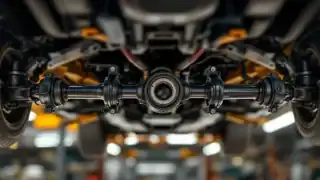
A CV axle (short for constant velocity axle) is what transfers drive from your gearbox to your wheels, allowing the axle to flex through steering and suspension movement while still delivering smooth, consistent power. Japanese vehicle CV axle replacement is one of the more common drivetrain jobs we see at Gatton Automotive Solutions, and for good reason. Japanese makes like Toyota, Honda, Mazda, Nissan, Subaru, and Mitsubishi are everywhere in the Lockyer Valley, and their front-wheel-drive and all-wheel-drive layouts put these axles under real daily load. When a CV axle or its protective boot fails, the consequences range from an annoying click to a vehicle that simply won’t move.
What Does a Failing CV Axle Feel or Sound Like?
The most recognisable sign is a sharp clicking or clunking noise when turning, especially at low speed or under acceleration. You might notice it pulling into a driveway or making a tight turn in a carpark. That sound comes from a worn CV joint, which is the internal mechanism inside the axle that allows it to flex and rotate simultaneously.
Other signs aren’t always as obvious. A torn or cracked CV boot, the rubber sleeve that protects the joint, is often spotted during a service or tyre rotation before any noise has started. Once that boot splits, the grease inside escapes and road grime gets in. From that point the joint wears quickly. Leaving it too long isn’t just a noise issue. A fully failed CV axle can leave you stranded, and in AWD Subarus and 4WD Toyotas, it can affect the behaviour of the entire drivetrain.
- Clicking or clunking during turns (especially slow, tight turns)
- Vibration through the floor or steering wheel under acceleration
- Grease splattered around the inside of a wheel or along the CV boot area
- A visible split or tear in the rubber CV boot
- Clunking when moving from reverse to drive, or under load from a standing start
How We Approach Japanese Vehicle CV Axle Repairs
Diagnosing a CV axle issue on a Japanese vehicle isn’t complicated if you know what you’re looking at, but it’s worth doing properly. We start with a physical inspection, checking the CV boots on both inner and outer joints, looking for splits, grease loss, and wear. On all-wheel-drive models like the Subaru Forester, Toyota RAV4, or Mitsubishi Outlander, we check both front and rear axles because AWD layouts can stress the rear CV joints in ways that front-wheel-drive vehicles don’t experience.
If the boot is torn but the joint itself is still in good condition, CV boot replacement may be sufficient. We pack the joint with fresh grease, fit a new boot, and seal it properly. In many cases on older Japanese vehicles or high-kilometre examples, we’ll recommend replacing the full CV shaft rather than just the boot, because the joint has already worn to the point where a boot replacement alone is a short-term fix.
Japanese vehicles generally use well-documented axle specifications, and parts availability for Toyota, Honda, Nissan, Mazda, and Mitsubishi is strong. We source parts to OEM specification or genuine-equivalent quality, which matters because a cheap aftermarket CV axle can introduce vibration or fail prematurely. For something like a high-kilometre Hilux or a Subaru with an AWD centre differential, fitting the right part to the right torque spec is non-negotiable.
Subaru and AWD-Specific Considerations
Subaru’s symmetrical AWD system is well loved in the Lockyer Valley for handling the mix of highway runs and rural roads around Gatton, but it does mean four CV axles instead of two. When we service Subaru CV axles, we always check axle shaft runout and inspect the differential seals at the same time, because a leaking diff seal can contaminate a new CV joint quickly. It’s a small check that saves a repeat job.
What Affects the Cost and Timing of CV Axle Work?
A few variables influence how involved the job becomes. The main ones are whether just the boot needs replacing or the entire axle shaft, the specific make and model (parts for a common Corolla or Navara are easy to source; some older or less common models take longer), and whether the vehicle is front-wheel-drive or all-wheel-drive. AWD vehicles simply have more axles and more joints to inspect.
We’re upfront about what we find and what we recommend. If a boot replacement will genuinely solve the problem, that’s what we’ll suggest. We don’t push a full axle replacement unless it’s warranted by the condition of the joint itself.
Why Lockyer Valley Drivers Bring Their Japanese Vehicles to Us in Gatton
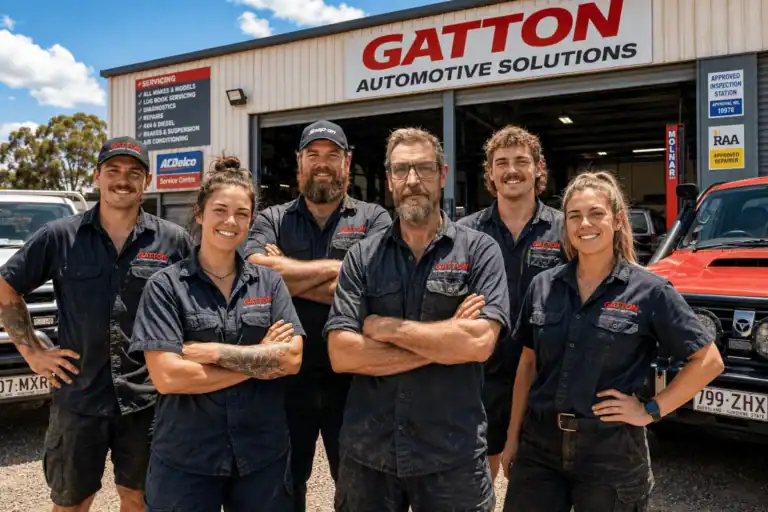
Gatton Automotive Solutions handles everything from everyday Corollas and Mazda 3s through to heavy utes, 4WDs, and farm equipment. You don’t need to drive to Ipswich or Toowoomba for drivetrain work on your Japanese vehicle. We’ve built a reputation locally for straight advice and fair pricing, and our five-star rated reviews reflect that. Parts sourcing is handled in-house, so we’re not sending you elsewhere while your car sits waiting.
Beyond CV joint repairs and replacement, our workshop covers roadworthy certificates, suspension upgrades, tyre supply and fitting, smash repairs, custom paintwork, and agricultural equipment servicing. It’s a genuinely full-service workshop, all in the one place right here in Gatton.
If you’ve noticed a clicking noise on turns, spotted a split boot, or just want the underside of your vehicle checked, Call Us Now or Book Your Free Inspection online. We’re here in Gatton and ready to take a look.