A Japanese vehicles logbook service follows the exact maintenance schedule your manufacturer set out in your owner’s manual, covering every inspection point, fluid, and filter your car needs at each kilometre interval. Japanese brands like Toyota, Mazda, Nissan, Honda, Mitsubishi, and Subaru each publish their own service intervals and specifications, and sticking to that schedule is one of the most straightforward ways to keep your vehicle running well and your ownership costs predictable. For drivers in Gatton and across the Lockyer Valley, having that service done locally means no half-day round trip to Ipswich or Toowoomba every time your service light comes on.
Why Japanese Vehicles Have Their Own Logbook Requirements
Japanese manufacturers are known for tight engineering tolerances and brand-specific fluid specifications. A Toyota, for example, typically specifies engine oil viscosity grades and transmission fluid types that differ from what a European or American vehicle requires. Subaru boxer engines have their own timing and oil consumption characteristics worth monitoring closely. Mitsubishi turbodiesel utes popular with tradies and farmers around Gatton carry specific filter and fuel system service points that a generic service checklist may miss entirely.
Following the manufacturer’s own log book service schedule also matters if your vehicle is still under a new car or extended warranty. Under Australian consumer law, you’re generally entitled to have your car serviced by a qualified independent mechanic without voiding your manufacturer warranty, provided the service meets the required standard and is properly documented. That said, your specific circumstances may vary, so it’s worth checking your warranty conditions directly.
Signs Your Japanese Vehicle Is Overdue for a Logbook Service
Sometimes the service indicator light tells you clearly. Other times, the signs are subtler. Watch for:
- Engine oil that looks dark and thick on the dipstick, or a low oil level between services
- A rough idle or slight hesitation on startup, especially on colder mornings
- Brake pedal travel that feels slightly longer than normal, or squealing from the pads
- Transmission that’s slower to engage or shifts with a small shudder
- Air conditioning that’s not cooling as effectively as it should
- Tyres wearing unevenly, which can point to wheel alignment or suspension issues that a logbook inspection would catch
Even if none of these are present, a vehicle approaching its next kilometre or time interval is worth booking in. Japanese vehicles are generally reliable, but that reliability comes from consistent maintenance, not from skipping it.
What a Japanese Vehicle Log Book Service Includes
We work through your vehicle’s specific service schedule rather than a one-size-fits-all checklist. For most Japanese vehicles, a standard logbook service at Gatton Automotive Solutions covers an engine oil and filter change using the manufacturer-specified grade, inspection of all fluid levels including coolant, brake fluid, power steering fluid, and transmission fluid, replacement of the air filter and cabin filter where the schedule requires it, and a brake inspection covering pads, rotors, and fluid condition.
We also check the battery condition and charging system, inspect belts and hoses for wear or cracking, test tyre pressures and tread depth, and look over the steering and suspension components. Every item inspected is noted in your log book, and we’ll talk you through anything that needs attention before we do anything outside the scheduled scope.
OEM-Spec Parts for Japanese Makes
We source parts suited to your vehicle’s specifications, including OEM-equivalent oils, filters, and fluids. For Japanese vehicles this matters more than people often realise. Using the wrong automatic transmission fluid in a Toyota or Nissan CVT, for instance, can cause real problems over time. We match the spec to the vehicle, and we’ll always tell you what we’ve used and why.
What Affects the Cost and Time for a Logbook Service?
The main variables are the vehicle’s service interval stage, your make and model, and whether any additional work is identified during the inspection. A minor service at a standard interval is generally quicker and more straightforward than a major service that includes spark plug replacement, fuel filter change, or timing belt inspection. Parts availability for Japanese vehicles is generally good across the Lockyer Valley, and our team handles parts sourcing directly so there’s no back-and-forth between you and a supplier.
If we find something during the service, we’ll let you know the detail and the cost before any additional work begins. We don’t add items to a job without talking to you first.
Servicing Japanese Vehicles in Gatton Without the Drive
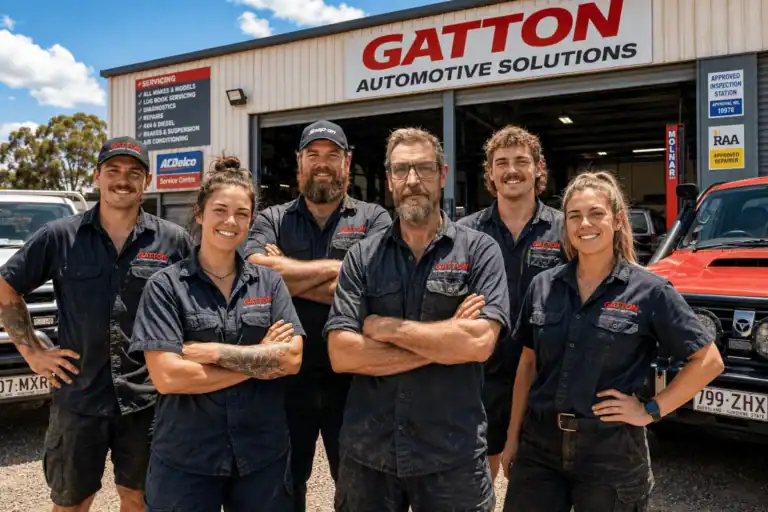
Gatton Automotive Solutions handles everything from everyday Corollas and Mazda3s to Hilux utes, Subaru Foresters, and larger commercial Japanese vehicles, all in the one workshop. We issue roadworthy certificates on-site, do suspension and tyre work in-house, and handle fleet vehicles for local businesses who need their vehicles kept on the road. There’s no need to drive to a dealership in a larger town for a routine log book service when the work gets done properly right here in Gatton.
Our team has built a strong local reputation across Gatton and the wider Lockyer Valley, backed by five-star reviews from customers who keep coming back. That kind of trust takes time to earn, and we don’t take it lightly.
Ready to get your Japanese vehicle’s logbook service sorted? Book Your Free Inspection online or Call Us Now and we’ll lock in a time that works for you.