Brake fluid is one of those things that rarely gets mentioned at a service — but it plays a direct role in whether your brakes work properly when you need them most. A Land Rover brake fluid change is a straightforward procedure, but skipping it on schedule can quietly degrade your braking performance over time. Drivers across Gatton and the Lockyer Valley who rely on their Defender, Discovery, or Range Rover for daily commuting, towing, or farm access need their brake system performing to spec — not gradually deteriorating in the background.
Why Brake Fluid Degrades Over Time
Brake fluid is hygroscopic, which means it absorbs moisture from the air over time. That’s not a flaw — it’s by design. The fluid is formulated to pull moisture in rather than allow it to pool and corrode brake lines or caliper bores. But as the moisture content climbs, the fluid’s boiling point drops. Under hard braking — towing a trailer on the Warrego Highway, descending a range, or stopping quickly in traffic — overheated fluid can vaporise. Vapour compresses where liquid doesn’t, and the result is a soft, spongy pedal that doesn’t stop the vehicle the way it should. This is known as brake fade, and it’s a real risk when fluid is well past its replacement interval.
Land Rover vehicles, particularly those with Electronic Air Suspension and sophisticated stability control systems, place higher thermal and hydraulic demands on the brake circuit than many comparable 4WDs. That’s an important reason to follow Land Rover’s own service schedules rather than treating this as a one-size-fits-all job.
Signs Your Land Rover May Need a Brake Fluid Change
Unlike a worn brake pad, degraded fluid rarely gives you a dramatic warning. But there are a few things worth paying attention to:
- A soft or spongy brake pedal that feels different from how it used to — particularly noticeable when the brakes are hot
- Longer stopping distances, especially under repeated braking on a descent or in stop-start traffic
- A brake warning light appearing on the dashboard (Land Rovers will flag fluid level drops via the instrument cluster)
- Time or mileage — if you can’t remember the last fluid change, it’s probably overdue
- Discolouration of the fluid — fresh DOT fluid is pale amber; dark or murky fluid has absorbed too much moisture
Land Rover’s service schedule generally recommends changing brake fluid every two years regardless of kilometres covered. This interval exists because moisture absorption is time-dependent, not just usage-dependent. A Discovery that spends most of its time parked still needs its fluid changed on that two-year cycle.
What a Land Rover Brake Fluid Change Involves at Our Workshop
We start by checking the current fluid condition and level in the reservoir. We also inspect the brake lines, master cylinder, and caliper fittings for any corrosion, weeping, or damage before starting — there’s no point flushing fluid into a system that has a developing issue elsewhere.
The old fluid is then fully flushed from the system. This matters more than just topping up, because a partial top-up dilutes rather than replaces degraded fluid. We bleed each caliper in the correct sequence to clear air and old fluid, working through to a clean, consistent flow of fresh fluid at every corner of the vehicle.
For Land Rovers, we use fluid that meets the OEM specification — typically DOT 4 or DOT 4+ depending on the model and year. Some later-model Range Rover and Discovery variants have specific fluid requirements that differ from a generic workshop’s default supply. We source parts and fluids with the specific vehicle in mind, not just whatever’s on the shelf.
Does This Affect My Warranty?
Australian consumer law generally allows you to have your Land Rover serviced by a qualified independent mechanic without voiding your manufacturer warranty, provided the work meets the required standard and the correct specification fluids are used. This is general information, not legal advice — we’d encourage you to check your own warranty terms if you have questions about your specific situation.
What Affects the Cost and Time for a Brake Fluid Change in Gatton?
A brake fluid change is one of the faster fluid services we carry out. The main variable is whether we find anything else that needs attention during the inspection — a corroded bleed nipple, a seeping line fitting, or a caliper that hasn’t been touched in years can add time to the job. The fluid specification for your particular Land Rover model also plays a role, as some variants require a higher-spec fluid that costs more per litre but is non-negotiable for proper operation. We’ll tell you what’s involved before we start.
Locally Owned, Full-Service Workshop in Gatton
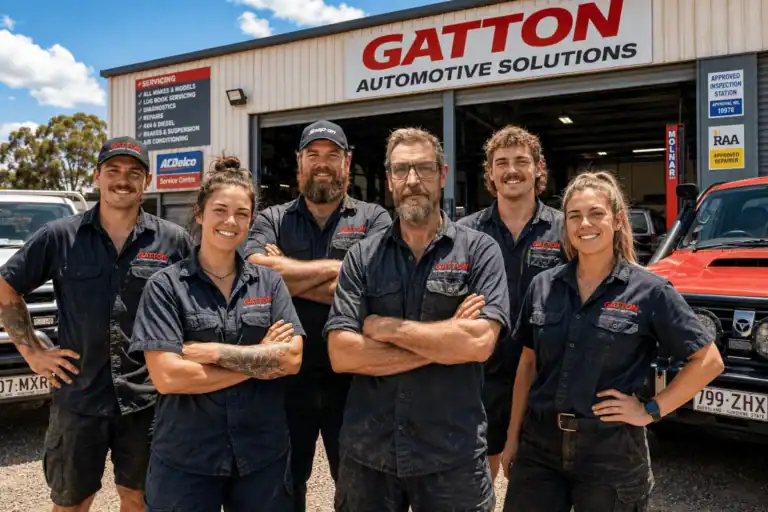
Gatton Automotive Solutions handles everything from everyday car servicing through to heavy vehicle and equipment work, smash repairs, suspension upgrades, tyre supply and fitting, roadworthy certificates, and agricultural machinery — all under one roof. For Land Rover owners in the Lockyer Valley, that means no driving to Ipswich or Toowoomba for work that can be done locally, with honest advice and straight pricing. We don’t recommend work that isn’t needed, and we don’t dress up a simple service into something bigger. With five-star reviews behind us, we’ll let the results speak for themselves.
If your Land Rover is due for a brake fluid change, or you’re not sure when it was last done, Call Us Now or Book Your Free Inspection online. We look after drivers across Gatton and the wider Lockyer Valley region.