Limited Time: Free Windscreen Wipers With Any Service. Subject To Availability.

Locally Owned & Operated
Honest Upfront Pricing
5★ Reviews
All Makes & Models

Verified 5★ Reviews

Reliable Volkswagen Timing Belt Replacement In Gatton

Timing belt replacement for Volkswagens in Gatton keeps your engine running safely and on schedule. We use quality parts, verify engine timing, and save you the trip to Ipswich or Toowoomba.

One-Stop Workshop

Honest Advice

5★ Reviews

VW Timing Belt Specialists

Book Your Free Inspection

Tell us what you need and we'll get back to you with a clear quote.

Booking Form
  • Vehicle Details
  • Confirm Vehicle
  • Services
  • Contact Details
Honest Quotes
All Vehicle Types
Local & Reliable

Why Book With Us

Book Your Free Inspection
Drop Off Your Vehicle
We Get to Work
Collect Your Car

A Volkswagen timing belt replacement is one of the most important scheduled maintenance items on your car — not because something has gone wrong, but because waiting until something does go wrong is an expensive mistake. The timing belt (also called a cam belt) keeps your engine’s camshaft and crankshaft rotating in precise coordination. If it snaps or slips, the engine’s valves and pistons can collide, causing serious internal damage. For Volkswagen owners in Gatton and across the Lockyer Valley, getting this service done on schedule is far cheaper than the alternative.

How Do You Know When a Volkswagen Timing Belt Needs Replacing?

Volkswagen timing belts are a scheduled replacement item, not a wait-and-see one. Unlike brake pads or tyres, a worn cam belt often shows no obvious symptoms before it fails. That’s what makes it different from most other services — by the time something feels wrong, the belt may have already let go.

That said, there are situations where inspection becomes urgent sooner than the service interval suggests:

  • Your VW has exceeded the manufacturer’s recommended replacement interval (in kilometres or years, whichever comes first)
  • You’ve recently bought a used Volkswagen and the service history doesn’t clearly confirm when the belt was last replaced
  • A ticking or slapping noise is coming from the engine bay, particularly on cold starts
  • The engine is misfiring or running roughly without any obvious ignition or fuel cause
  • You’ve had the car sitting unused for an extended period — rubber degrades over time regardless of kilometres

Volkswagen specifies replacement intervals that vary by engine type and model year. Some older 1.4 TSI and 1.6 TDI engines have relatively short intervals compared to larger-displacement units. If you’re unsure of the interval that applies to your specific VW, we can check that for you before any work is agreed.

What’s Involved in a VW Timing Belt Replacement?

This isn’t a quick job, and any workshop treating it as one is cutting corners. Accessing the timing belt on most Volkswagen engines requires partial disassembly of ancillary components, so we always take the opportunity to inspect everything in that area while it’s accessible.

Our process includes:

  • Removing covers and ancillary components to access the timing belt assembly
  • Inspecting the existing belt for cracking, glazing, fraying, or tooth wear
  • Replacing the belt itself using parts that meet VW OEM specifications
  • Replacing the tensioner and idler pulleys at the same time — these components wear at a similar rate and re-using old pulleys with a new belt is a false economy
  • Replacing the water pump if it is driven by the timing belt on your engine (common on many VAG-group four-cylinder engines) — since the labour to reach it is already done, replacing it now avoids a repeat job later
  • Checking and resetting valve timing to manufacturer specification
  • Checking for any oil leaks from the cam seals or crank seal that could contaminate the new belt

On many popular VW models, including the Golf, Jetta, Polo, Tiguan, and Amarok variants fitted with belt-driven timing systems, the water pump replacement during the same service is standard workshop practice. We’ll always explain what’s included and why before starting work.

What Affects the Cost of Timing Belt Replacement on a Volkswagen?

The cost of a Volkswagen cam belt replacement varies depending on a few honest factors. Engine type and model year affect how labour-intensive the job is. A transversely mounted four-cylinder is a different scope to a longitudinally mounted V6 or TDI diesel variant. The Amarok’s V6 TDI, for example, is a more involved job than a standard Polo or Golf.

Whether the water pump and seals are included also affects the total. We’ll be upfront about what’s recommended for your specific engine and let you make an informed call. We source parts to OEM-equivalent specification — using the correct belt kit for your engine family, not a generic part that might not meet the dimensional and tension requirements Volkswagen engineering demands.

We never pad a job with unnecessary inclusions, but we also won’t send you away with a new belt on old pulleys just to keep the ticket price down.

Volkswagen Servicing in Gatton Without the Drive to Ipswich or Toowoomba

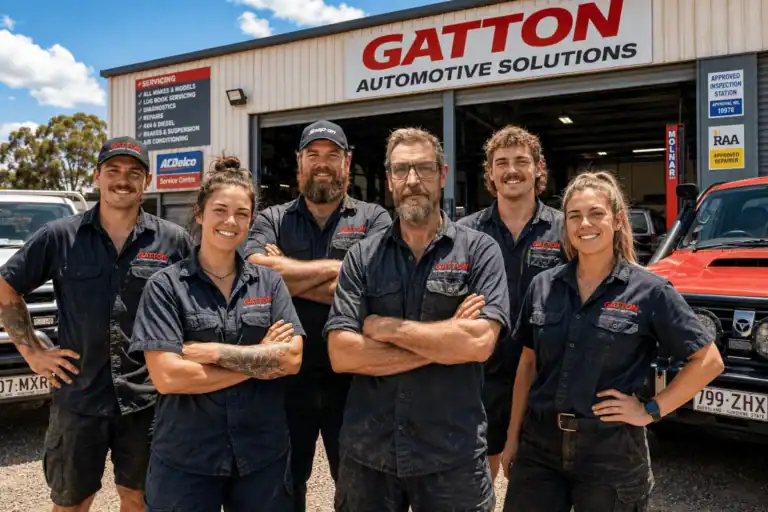
Gatton Automotive Solutions handles everything from standard hatchback and SUV servicing through to diesel utes, trucks, and heavy equipment — all under one roof. For Volkswagen owners in Gatton, Laidley, Plainland, Lowood, and across the Lockyer Valley, that means you don’t need to add 45 to 80 kilometres to a job that can be done locally by a team who know what they’re doing.

We hold five-star reviews from local customers, and we’ve built that reputation on straightforward advice and fair pricing. No upselling. No work done without your approval. If the belt is fine and the interval hasn’t been reached, we’ll tell you that too.

Parts sourcing is handled in-house, which means we can get what your VW needs without adding unnecessary delays to the job. We also issue roadworthy certificates on-site if you need one alongside your service work.

Ready to Book Your VW Timing Belt Replacement?

Don’t wait for a belt failure to make the decision for you. Call Us Now or Book Your Free Inspection online, and we’ll confirm the right service interval and inclusions for your Volkswagen before any work begins. Our Gatton workshop is ready to help you keep your VW running as it should.
Your Local Workshop for Every Vehicle

Gatton Automotive Solutions is the one-stop shop for cars, 4WDs, trucks, and heavy equipment. Honest advice and fair pricing, right here in Gatton.

Honest Pricing, No Surprises

We tell you what’s needed and what it costs before we start. No upselling, no pressure.

Everything Under One Roof

Bring your car in and we’ll inspect it, explain what we find, and quote you upfront.

Volkswagen-Trained Technicians

We know VW engines inside out and source OEM-spec parts to keep your warranty intact.

How Volkswagen Timing Belt Replacement Works

From booking through to collection, here's how we handle your Volkswagen timing belt replacement.

Step 1

Book Your Free Inspection

Call Us Now or book your free inspection to assess your timing belt condition and schedule replacement.

Step 2

Volkswagen Belt Assessment

We inspect the belt for wear, cracking, and age, then check tensioner and pulley condition using VW-specific procedures.

Step 3

Precision Belt Replacement

We replace the old belt with OEM-specification parts and adjust tension to Volkswagen factory settings.

Step 4

Final Check and Collection

We test-run your Volkswagen, confirm smooth operation, and hand your vehicle back ready for the road.

Five-Star Rated

Verified 5★ Reviews

Quality Parts From Trusted Suppliers

We use genuine and quality aftermarket parts from reputable suppliers. You get reliable components backed by proper warranties.

Book Your Free Inspection

Tell us what you need and we'll get back to you with a clear quote.

Booking Form
  • Vehicle Details
  • Confirm Vehicle
  • Services
  • Contact Details
Honest Quotes
All Vehicle Types
Local & Reliable

Why Book With Us

Book Your Free Inspection
Drop Off Your Vehicle
We Get to Work
Collect Your Car

Frequently Asked Questions

Browse answers to common questions about our services. Can't find what you're after? Give us a call and we'll help.

Most Volkswagen models have a recommended replacement interval listed in the owner’s manual, typically based on kilometres or years, whichever comes first. There are rarely obvious warning signs before a belt fails, which is exactly why sticking to the schedule matters. If you’re unsure when yours was last done, or you’ve bought the car second-hand without full service records, it’s worth having it inspected. A worn belt can show cracking or fraying, but by the time those signs appear, the risk of failure is already real.

If the timing belt snaps on a running engine, the result is almost always serious internal damage. On interference engines, which most Volkswagen petrol and diesel engines are, the pistons and valves occupy the same space at different times. Without the belt keeping them in sync, they collide. That means bent valves, damaged pistons, and in some cases a written-off engine. Replacing the belt on schedule costs a fraction of an engine rebuild. It’s one of the clearest examples of preventive maintenance paying for itself.

A proper Volkswagen cam belt replacement should include the belt itself, the tensioner pulley, idler pulleys, and in most cases the water pump. On many VW engines, the water pump is driven by the timing belt and sits in the same service area, so replacing it at the same time avoids paying for the labour twice down the track. Skipping the water pump to save a small amount now is a false economy if it fails before the next belt service.

For most Volkswagen models, the job typically takes a few hours in the workshop. Some engine configurations are more straightforward than others, and access varies between models. We’ll give you a realistic timeframe when you book, based on your specific vehicle. Many customers drop their car off in the morning and collect it the same day. If you’re local to Gatton, we’re easy to reach and can let you know as soon as it’s ready.

Some Volkswagen TDI diesel engines, particularly older 1.9 and 2.0 litre variants, have a reputation for timing belt failures when service intervals are stretched or the full kit is not replaced. The tensioners and idler pulleys on these engines can deteriorate independently of the belt itself, and a failed tensioner causes the same damage as a snapped belt. It’s also worth knowing that certain VW petrol engines use a timing chain rather than a belt, so the service requirements differ. We can confirm which system your specific model uses.

Under ACCC guidance, Australian consumer law generally does not require you to use a dealership for scheduled servicing in order to maintain your manufacturer warranty. An independent workshop can perform the service provided it meets the manufacturer’s specifications and the work is properly documented. This is general information, not legal advice, so it’s worth reviewing your specific warranty terms if you have any concerns. We stamp and document your logbook and use quality parts suited to your vehicle’s requirements.

The main variables are the specific engine in your Volkswagen, whether the water pump is included, and the parts used. Some VW engines have more complex timing setups that require additional time and components. The cost of parts also varies depending on whether OEM-equivalent or manufacturer-branded components are used. We’ll give you a clear quote before any work begins so there are no surprises. We handle parts sourcing in-house, which keeps things straightforward for you.

Replacement intervals vary across VW models and engine types, but many fall in the range of every four to five years or every 100,000 kilometres, whichever comes first. Some older diesel engines have shorter recommended intervals. Always check your owner’s manual for the figure specific to your model, or ask us to look it up for you. Volkswagen’s interval recommendations tend to be conservative for good reason, given the consequences of a belt failure on an interference engine.

We use quality parts suited to your Volkswagen’s specifications, which typically means OEM-equivalent timing belt kits from reputable suppliers. These meet or match the material and dimensional standards of the original components. If you specifically want manufacturer-branded parts, let us know when you book and we can discuss what’s available and what that means for the overall cost. The goal is always a reliable, correctly specced repair.

If you genuinely don’t know when the belt was last replaced and your Volkswagen is approaching or past the recommended interval, we’d suggest booking an inspection sooner rather than later. There’s no reliable way to judge remaining belt life from the driver’s seat. Drivers in and around Gatton who’ve bought second-hand vehicles without full service histories come to us regularly for exactly this kind of check. It’s a straightforward assessment, and it’s far better than finding out the hard way.

When you drop your car off, we’ll confirm the scope of work and let you know the expected completion time. The vehicle goes straight into the workshop where the old belt, tensioners, and associated components are removed and inspected. Replacement parts are fitted and the timing is set to the manufacturer’s specification before the engine is tested. We’ll contact you once it’s done and walk you through what was replaced. Most customers are back on the road the same day.

Yes, the belt can be visually inspected for signs of wear such as cracking, glazing, or fraying, and the tensioner condition can also be checked. However, visual inspection has limits. A belt can look acceptable and still be past its safe service life, especially if it’s aged or has been exposed to oil contamination. If your vehicle is near or past the recommended interval, an inspection is a useful starting point, but replacement is usually the more sensible outcome given what’s at stake.

Continue to site