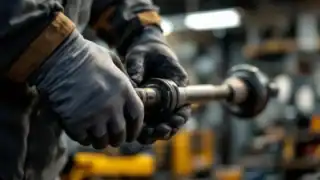
A vibration through the floor at highway speed, a clunking noise when you pull away from the lights, or a shudder every time you change gears — these are the kinds of things that send Jeep owners in looking for Jeep tailshaft repair. The tailshaft (also called the propeller shaft or driveshaft) is the rotating component that transfers power from your gearbox to your front or rear differential. On a Jeep, this shaft takes a real hammering — particularly if you use your vehicle for towing, off-road runs, or carrying heavy loads around the Lockyer Valley. Gatton Automotive Solutions carries out Jeep tailshaft repairs on a range of models, from the Wrangler and Grand Cherokee through to the Cherokee and Gladiator.
Warning Signs Your Jeep’s Tailshaft Needs Attention
Tailshaft problems rarely appear out of nowhere. Most start small and get progressively worse if left alone. Catching them early usually means a simpler fix.
- Vibration through the cabin or floor that worsens with speed, particularly noticeable between 80 and 110km/h
- Clunking or banging on acceleration or deceleration, often felt as a jolt when you ease on or off the throttle
- Squealing or squeaking from underneath the vehicle, especially during slow-speed manoeuvres
- Shuddering when pulling away from a standing start, sometimes mistaken for a transmission issue
- Visible grease splatter under the vehicle near the shaft, which points to a failed universal joint (U-joint) seal
- Loose or knocking movement felt when rotating the tailshaft by hand with the vehicle raised safely on a hoist
If you’re noticing any of these signs, it’s worth getting the shaft properly inspected before a worn component causes secondary damage to your differential, gearbox output shaft, or transfer case.
What the Inspection and Repair Process Looks Like
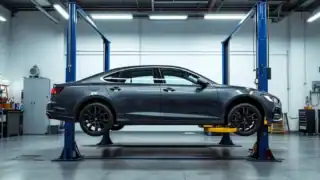
We start by putting the Jeep on the hoist and doing a thorough visual inspection of the entire driveline. Jeep’s 4WD systems — particularly the Command-Trac and Selec-Trac transfer cases found across the JK and JL Wrangler generations — use a two-piece tailshaft arrangement with a centre bearing that can degrade quietly over time. That centre support bearing (also called the carrier bearing) is a common failure point on higher-kilometre Wranglers and Grand Cherokees, and it’s worth checking even when the primary complaint is a U-joint.
From there, we assess each universal joint for play, corrosion, and wear. U-joints on Jeeps used for off-road driving tend to wear faster than the same vehicle used purely on-road — the constant changes in shaft angle and load cycle place more stress on the needle bearings inside the joint. We check the slip yoke (the sliding section that allows the shaft to change length as the suspension moves) for wear and correct lubrication.
If the shaft itself is bent, we’ll tell you clearly. A bent tailshaft can’t be straightened reliably — it needs to be replaced, and we’ll source a quality replacement shaft that meets the correct specifications for your specific Jeep model and drivetrain configuration. Where U-joints and the carrier bearing are the issue, we replace them with components rated to at least OEM specification. Genuine-equivalent or OEM-spec parts matter on Jeeps, particularly on Wranglers where aftermarket components vary widely in quality.
Jeep Tailshaft Repair in Gatton: What Affects the Cost
The cost of tailshaft work depends on a few honest variables. A straightforward U-joint replacement on a two-wheel-drive Cherokee is a different job to a full tailshaft replacement on a lifted JL Wrangler Rubicon with a two-piece rear shaft. Factors that affect the final price include:
- Whether the repair involves U-joints, the carrier bearing, the slip yoke, or a full shaft replacement
- The specific Jeep model and drivetrain (4WD and AWD vehicles have front and rear shafts, each with their own components)
- Parts availability for your model — some older Cherokee and Compass variants require sourced or ordered components
- Whether any related damage to the differential or gearbox flange needs to be addressed at the same time
We’ll give you a straight assessment of what the job involves before any work starts. No surprises, no additions that weren’t agreed upfront.
Why Lockyer Valley Jeep Owners Use Our Workshop
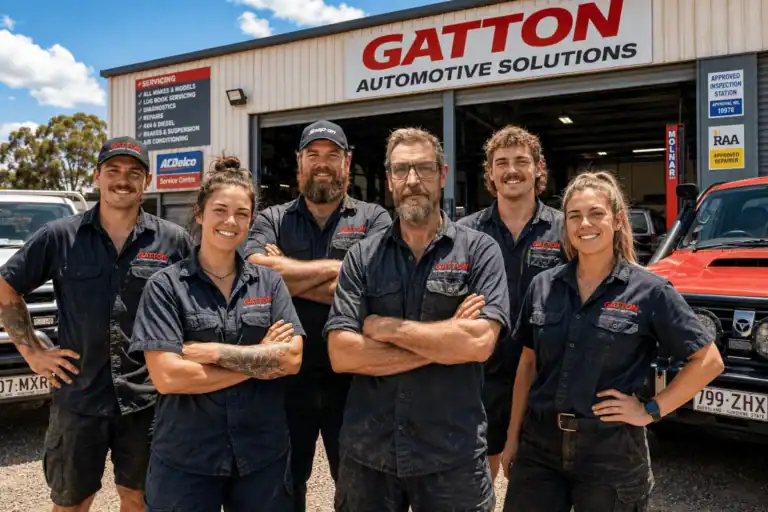
Gatton Automotive Solutions is a full-service workshop handling everything from everyday passenger cars to 4WDs, light trucks, and heavy equipment — all under one roof in Gatton. There’s no need to drive to Ipswich or Toowoomba for driveline work on your Jeep when it can be done locally by a team that sees these vehicles regularly.
We handle the parts sourcing ourselves, so you’re not chasing components across three suppliers. Roadworthy certificates are issued on-site. And if your Jeep needs additional work identified during the inspection — suspension, tyres, or anything else — we can assess and quote that at the same time rather than sending you somewhere else.
With five-star reviews from drivers across the Lockyer Valley, the workshop’s reputation is built on giving people honest advice and doing the job properly the first time.
If your Jeep is showing signs of driveline trouble, Call Us Now or Book Your Free Inspection online. We’ll take a proper look and tell you exactly what’s needed — no guesswork, no unnecessary work, just a clear answer from a workshop that knows Jeeps.