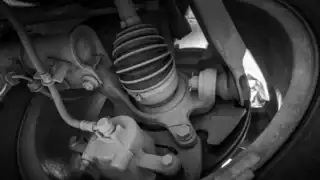
The tailshaft is the rotating shaft that transfers drive from your gearbox to the rear differential, and when it develops a problem, you’ll know about it quickly. Mercedes Tailshaft Repair is something we handle regularly at Gatton Automotive Solutions, and it’s a job that rewards prompt attention. A worn or damaged tailshaft doesn’t just make the drive uncomfortable, it can escalate into more serious drivetrain damage if it’s left alone. Whether you’re driving a C-Class daily commuter, an E-Class on the Warrego Highway, or a Mercedes-Benz Sprinter van doing runs through the Lockyer Valley, the fundamentals of keeping your tailshaft in sound condition are the same.
What Does a Failing Tailshaft Feel Like?
Mercedes vehicles are known for refinement, so when something feels off in the drivetrain, it’s usually noticeable. The most common sign is a vibration through the floor, often most pronounced at highway speeds or during acceleration. Some drivers describe it as a shudder that comes and goes, while others notice it only when pulling away from a standstill.
Beyond vibration, listen for clunking or knocking sounds when you shift from drive to reverse, or when you accelerate after coasting. These noises often point to worn universal joints (the cruciform fittings at each end of the shaft) or a failing centre bearing on two-piece tailshaft assemblies. On some Mercedes models, a worn tailshaft rubber coupling, known as a flex disc or guibo, is the culprit. This component is specific to Mercedes and certain European drivetrains and is designed to dampen torque shock, but it degrades over time and can crack or separate.
- Vibration through the seat or floor at highway speeds
- Clunking when changing between drive and reverse
- Shuddering on acceleration, especially from low speed
- Squealing or squeaking from underneath the vehicle
- Visible grease splatter under the car near the driveshaft
- Knocking sound from the drivetrain during tight turns or manoeuvres
If you’re seeing grease splatter under the vehicle, that’s a strong sign a universal joint boot has failed and the joint is no longer lubricated. Don’t wait on that one. A dry universal joint can seize and cause the tailshaft to separate from the drivetrain entirely.
How We Diagnose and Repair Mercedes Tailshaft Problems
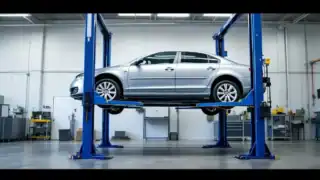
We start with a road test to reproduce the symptoms under real driving conditions, then move to a thorough undercar inspection with the vehicle on the hoist. We check the tailshaft for runout (any wobble in the shaft as it spins, which indicates a bent or imbalanced shaft), inspect each universal joint for play and lubrication condition, and examine the centre support bearing for wear or separation. On Mercedes-Benz vehicles, we also check the flex disc carefully, as this rubber coupling is a known wear item across the E-Class, C-Class, and Sprinter platforms and is often overlooked on standard inspections elsewhere.
If the universal joints are worn, we can replace them individually in many cases, though on some Mercedes models the tailshaft assembly is designed to be replaced as a whole unit. We’ll tell you which approach applies to your vehicle and why. Where the flex disc is the issue, replacement with an OEM-spec or genuine-equivalent part is important, as an undersized or incorrect-spec coupling can introduce vibration back into the drivetrain.
Any time the tailshaft is removed, we also check the tailshaft flange seals on the gearbox and differential for leaks, since the job provides easy access to inspect them. If there’s grease contamination on nearby components, we clean and inspect those areas too.
What Affects Repair Cost and Timeframes in Gatton
The cost of tailshaft repair on a Mercedes depends on a few honest variables. A single worn universal joint on a serviceable shaft is a different job to replacing a two-piece tailshaft assembly with a damaged centre bearing and cracked flex disc. Parts availability matters too. Genuine or OEM-equivalent parts for Mercedes vehicles take more care to source than high-volume domestic parts, and we’d rather take the time to get the right component than fit something that won’t last.
Labour time varies depending on whether it’s a single-piece or two-piece shaft arrangement, and whether any associated components need attention. We give you a clear assessment of what’s needed and what it will cost before any work begins. No surprises, no extra jobs added without your say-so.
Why Lockyer Valley Mercedes Owners Come to Us
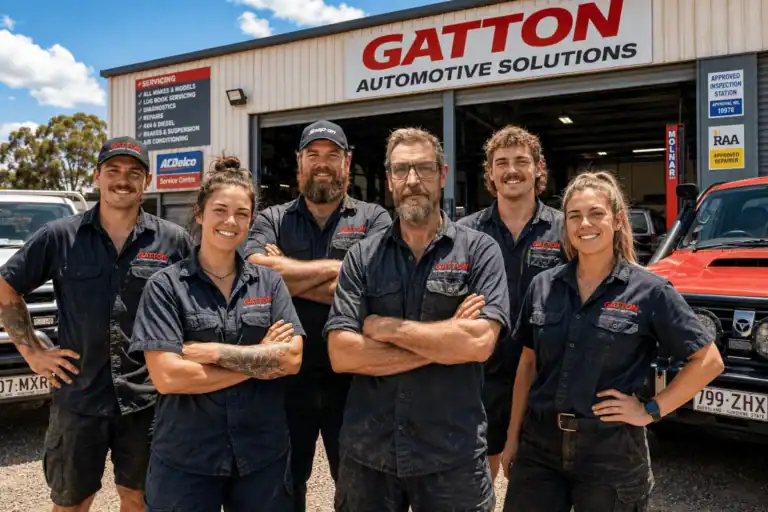
Getting your Mercedes tailshaft repaired doesn’t mean a drive to Ipswich or Toowoomba. Gatton Automotive Solutions is a full-service workshop handling everything from everyday passenger cars to 4WDs, trucks, and heavy equipment, all under one roof. Our team handles Mercedes mechanical work as part of a broad range of vehicle types, which means we’ve developed practical knowledge across the platform rather than seeing these vehicles occasionally.
We’re locally owned and operate on the straightforward principle of telling you what’s actually needed and doing that work properly. Our five-star reviews reflect that approach. We also handle parts sourcing in-house, which simplifies the process when you’re sourcing specific components for a European vehicle without a dealership nearby.
If your vehicle needs a roadworthy certificate once the repair is complete, we issue those on-site too. From general mechanical work for everyday drivers through to smash repairs, custom paintwork, suspension upgrades, and tyre supply and fitting, Gatton Automotive Solutions covers the full range without sending you elsewhere.
If your Mercedes is shuddering, clunking, or just doesn’t feel right on the road, Book Your Free Inspection online or Call Us Now. We’re based in Gatton and ready to take a look.