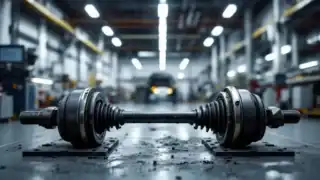
The tailshaft is a core part of how your Land Rover puts power to the ground. It’s the rotating shaft that transfers drive from the gearbox to the front and rear differentials, and on a four-wheel drive like a Land Rover, it’s working hard every time you move. Land Rover tailshaft repair covers everything from worn universal joints (UJs) and centre bearings through to damaged yokes and shaft imbalance. If something goes wrong with the tailshaft, you’ll feel it before long, and in Gatton and across the Lockyer Valley, a broken tailshaft on a dirt track or on the highway is not a situation you want to be in.
What Does a Failing Land Rover Tailshaft Feel Like?
Land Rover owners often describe the first signs as a vibration that builds as speed increases, sometimes appearing around 80-100km/h and easing off above that. That’s a classic sign of tailshaft imbalance or a worn universal joint. It’s easy to dismiss as a tyre or wheel balance issue, but the two feel different on the road and they have different causes.
Other symptoms to watch for include:
- A clunk or knock when pulling away from a stop, especially under load
- A metallic grinding or clicking noise from under the vehicle during low-speed turns
- Vibration through the floor or seat that gets worse with acceleration
- Visible grease spray under the vehicle, which often points to a failed UJ seal
- Shudder when switching between two-wheel and four-wheel drive modes
Land Rovers are used heavily across this region, from everyday driving around Gatton and Laidley to weekend work on rural properties. That mix of sealed road kilometres and rough off-road use puts genuine stress on tailshaft components. The front tailshaft in particular takes a beating when the vehicle is in 4WD and the front wheels are turning at full lock.
How We Diagnose and Repair Land Rover Tailshafts
We start with a physical inspection, checking for play in the UJs, condition of the centre support bearing if the shaft is a two-piece design, and whether there’s any visible damage to the shaft itself. Land Rovers, particularly the Discovery and Defender models, use constant velocity (CV) joints on the front tailshaft in some configurations, and these require a different approach to diagnosis than a standard cross-type UJ. We check both ends of each shaft and assess whether the issue is isolated to a single component or whether the whole shaft needs attention.
If the shaft needs to come off the vehicle, we balance-check it before refitting. A shaft that’s been knocked, even slightly, can throw the balance out enough to cause vibration at road speed. This is a step that matters and one we don’t skip.
For parts, we work with OEM-specification or quality equivalent components that meet Land Rover’s build tolerances. Running undersized or mismatched UJs in a vehicle that sees off-road use is a false economy. We source parts through our own channels, which keeps the process moving without unnecessary delays.
Defender and Discovery: Common Tailshaft Considerations
Older Defender models are well known for front propshaft issues, particularly the splined slip joint which can wear and cause clunking over rough terrain. Discovery Series II and III owners often encounter centre bearing wear on the two-piece rear propshaft. These aren’t faults that go away on their own. Left too long, a failed UJ can damage the transfer case output flange or the differential pinion flange, turning what was a straightforward repair into something far more involved.
What Affects Repair Time and Cost?
A single UJ replacement on a rear tailshaft is a fairly straightforward job. The complexity increases when you’re dealing with a two-piece shaft, a CV-type front propshaft, or when there’s secondary damage to flanges, yokes, or the transfer case. Parts availability matters too; some Land Rover components are not off-the-shelf items locally, and we factor that into the conversation upfront so you’re not caught out.
The age and specification of your vehicle also plays a role. A Defender TD5 and a current-generation Discovery 5 have very different drivetrain layouts, and repair processes reflect that. We’ll give you a clear picture of what’s involved before any work starts.
Why Gatton Land Rover Owners Choose Us
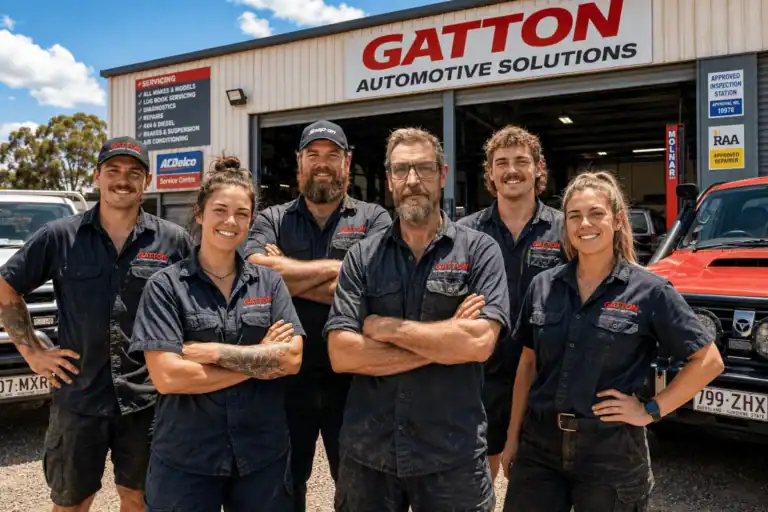
Gatton Automotive Solutions is a full-service workshop. We handle everything from everyday passenger cars through to 4WDs, utes, trucks, and heavy equipment, all under one roof. There’s no need to drive 45 minutes to Ipswich or Toowoomba for a propshaft repair. We’ve got the experience with four-wheel drives and working vehicles that this kind of job demands, and we back that with honest advice and straight pricing. No upselling, no unnecessary work.
We also issue roadworthy certificates on-site, handle suspension work and tyre fitting in-house, and can support fleet operators with multiple vehicles. If you’ve got a Land Rover that’s used for farm or property work, we understand what reliability means in that context.
Our five-star reviews reflect the way we work: tell the customer what’s wrong, explain what it takes to fix it, and do the job properly.
If your Land Rover is showing signs of tailshaft trouble, don’t leave it to chance. Book Your Free Inspection online or Call Us Now and let our team take a look at it here in Gatton.