Mercedes-Benz vehicles are engineered with brake systems that go well beyond the basics. The Mercedes brake repair work we carry out in Gatton covers everything from worn pads and scored rotors through to brake booster faults and electronic stability control issues. These systems are precise by design, and they need to be serviced with that precision in mind. If your Mercedes is pulling, pulsing, or just not stopping the way it should, it’s worth getting it looked at before the problem becomes a safety issue.
Warning Signs That Your Mercedes Brakes Need Attention
Mercedes drivers sometimes notice brake issues gradually, which makes it easy to put off the inspection. But these symptoms are worth taking seriously, particularly because Mercedes braking systems interact closely with the vehicle’s electronic driver assistance features.
- Squealing or grinding when braking: This often points to worn brake pads. Mercedes pads are typically fitted with wear indicators that produce a high-pitched squeal when the friction material is nearly exhausted. Grinding usually means metal-on-metal contact and rotor damage.
- Pulsing or vibration through the brake pedal: Commonly caused by brake rotor runout (where the rotor surface is no longer perfectly flat), which creates an uneven contact patch under braking pressure.
- A soft or spongy pedal: This can indicate air in the brake lines, a failing brake master cylinder, or a problem with the brake booster. Mercedes brake booster repair is a more involved job because the booster on many models is vacuum-assisted and tied to engine management.
- The vehicle pulling to one side when braking: Often points to a seized brake caliper or uneven pad wear across the front axle.
- The ABS or brake warning light illuminating on the dash: Mercedes uses a STAR-compatible diagnostic network that stores fault codes when brake sensors, ABS modules, or electronic parking brake components flag an issue.
Any one of these signs warrants a proper inspection. Combining multiple symptoms usually means the issue has progressed past early-stage wear.
How We Approach Mercedes Brake Repairs in Gatton
We start with a visual and mechanical inspection of the full braking system, which on a Mercedes includes more components than a standard domestic vehicle. Pad thickness, rotor condition, caliper movement, brake fluid condition, and brake line integrity are all checked. We also scan the vehicle’s fault codes using diagnostic equipment capable of reading Mercedes-specific DTC (diagnostic trouble code) data, which gives us a clear picture of whether any electronic braking or stability system faults are stored alongside the mechanical findings.
For Mercedes car brake repair, the parts we use are matched to OEM specifications. Mercedes rotors are manufactured to tight tolerances, and fitting undersized or incorrect-spec aftermarket rotors can create pedal pulsing and compromise the function of the ABS and ESC (Electronic Stability Control) systems. We source genuine-equivalent parts that meet the manufacturer’s specifications so the repaired system behaves as it was designed to.
Brake Fluid and Bleeding
Mercedes specifies brake fluid changes at regular intervals because brake fluid is hygroscopic, meaning it absorbs moisture from the air over time. As moisture content rises, the fluid’s boiling point drops, which increases the risk of brake fade under hard or prolonged braking. We test brake fluid condition and carry out a full system bleed where required, replacing fluid to spec.
Electronic Parking Brake Faults
Many Mercedes models from the C-Class, E-Class, and GLE onwards use an electronic parking brake (EPB) controlled by an actuator motor built into the rear caliper. Replacing rear brake pads on these vehicles requires the caliper piston to be retracted electronically, not manually. We carry the equipment to handle this correctly, which is something not every workshop in the Lockyer Valley is set up for.
What Affects the Cost and Time of a Mercedes Brake Repair?
Brake repair costs vary depending on which components need replacing, whether the work is front or rear (or both), and whether the rotors need replacing alongside the pads or can be retained. Mercedes rotors are generally more expensive than those fitted to mainstream domestic vehicles, and that’s reflected in parts pricing. That said, we’re transparent about what’s needed before any work begins. We’ll tell you what we found, what needs fixing, and what can wait, so you’re making an informed call.
Turnaround varies depending on parts availability and the scope of the repair. Straightforward pad and rotor jobs can often be completed while you wait. More involved work, like a Mercedes brake booster repair or an EPB actuator replacement, may require additional time or parts to be sourced. We’ll give you a realistic timeframe when we’ve inspected the vehicle.
Why Gatton Drivers Trust Us With Their Mercedes
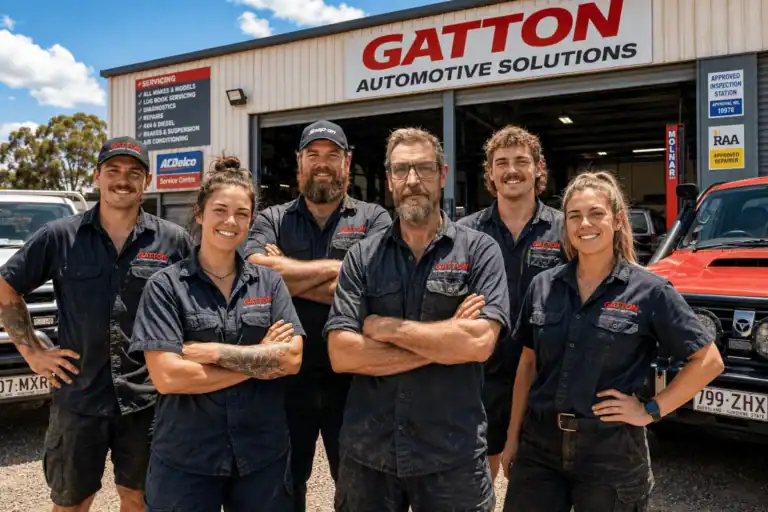
Gatton Automotive Solutions is a full-service workshop handling everything from everyday passenger cars and 4WDs through to trucks, heavy equipment, and agricultural machinery. For Mercedes owners in and around the Lockyer Valley, that breadth matters because it means you’re not bouncing between multiple workshops for mechanical, tyre, or related safety work. Roadworthy certificates are issued on-site, suspension work is done here, and parts sourcing is handled by the workshop directly.
We’ve built a strong local reputation, backed by five-star reviews, by being straight with people. No unnecessary work, no upselling, no vague estimates. If your Mercedes needs brake work, we’ll tell you exactly what it needs and why. For drivers who’d otherwise face a 45 to 80 kilometre trip to Ipswich or Toowoomba for specialist vehicle repairs, having this level of capability locally in Gatton is a genuine difference.
Book your free inspection online using Book Your Free Inspection, or Call Us Now to talk through what your Mercedes is doing. We’ll take a proper look and give you honest advice before any work gets started.